
Connected, visible, and safer care at every point.
When a scan can prevent a medication error or locate a missing infusion pump, the right hardware is patient-safety infrastructure. Arrowhead is a Zebra Advanced Healthcare Specialist and authorized Zebra Elite Service Center, serving hospitals, clinics, and labs nationwide with healthcare-grade mobile computers, disinfectant-ready scanners, RFID asset tracking systems, and barcode wristband programs that support positive patient ID (PPID), barcode medication administration (BCMA), specimen chain of custody, and real-time location of mobile medical equipment. Clinicians at the bedside—nurses, pharmacists, lab techs—need devices that survive repeated disinfection, respond instantly, and integrate with EHR systems. Biomedical engineering teams need those same devices repaired fast and returned with OEM parts. Arrowhead handles both: we design and deploy the workflow, supply Zebra HC-series mobile computers and scanners built for healthcare environments, and repair them in-house at our Chandler, AZ depot—no third-party hand-offs, no waiting weeks for a factory return. For healthcare facilities managing hundreds of infusion pumps, mobile workstations, and shared medical carts, RFID asset tracking eliminates the "equipment scavenger hunt" that costs nursing time and delays care. Arrowhead deploys passive UHF RFID and active RTLS systems that pinpoint equipment location in seconds, reduce lost-asset write-offs, and feed utilization data back to biomedical and supply chain teams.


Where the record gets created in healthcare
Clinical work is time-critical and the device is part of patient safety. A scanner that will not read a wristband, a wristband that smudges, or an infusion pump nobody can find all take time directly out of care.
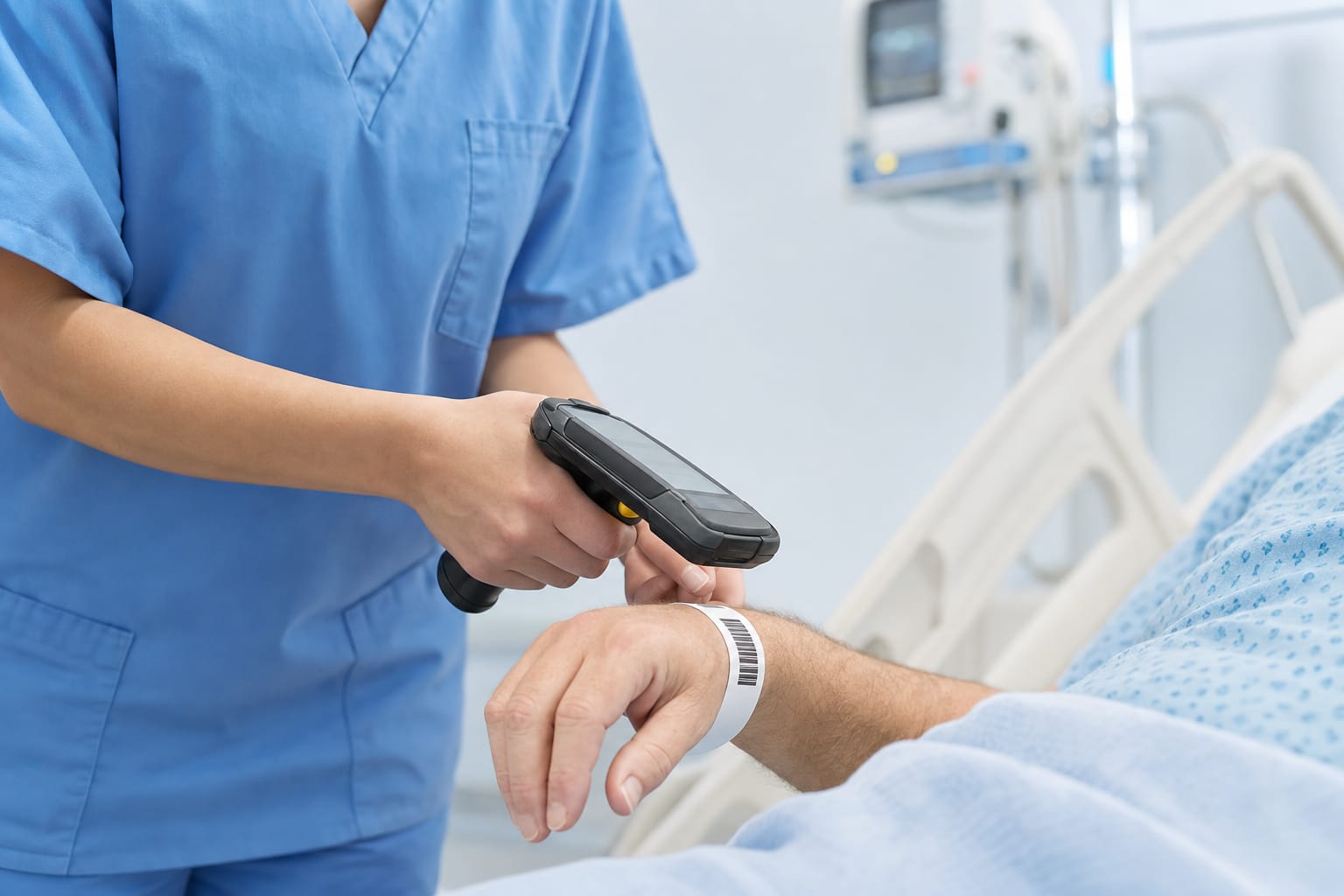
Positive patient identification at the bedside
- What physically happens
- A clinician scans the patient wristband and the medication before administration.
- What is captured
- Disinfectant-ready scanners and healthcare mobile computers read the wristband and the drug barcode at the bedside.
- What Mobi does with it
- None. The clinical check runs in the EHR. Arrowhead supplies, configures, and repairs the devices and the wristbands the check depends on.
- Where the result lands
- The EHR performs the verification and holds the administration record.
Specimen collection and chain of custody
- What physically happens
- A specimen is labeled at the point of collection and travels to the lab.
- What is captured
- The label is printed at the bedside and scanned at each handoff, so identity travels with the sample instead of with paperwork.
- What Mobi does with it
- Print Studio is where the specimen label layout and symbology are designed; label stock is produced by Arrowhead.
- Where the result lands
- The laboratory information system and the EHR hold the specimen record.
Mobile medical equipment location
- What physically happens
- An infusion pump, workstation, or cart moves between floors and units.
- What is captured
- RFID tags on the equipment are read by handheld sweeps or at floor boundaries so nurses stop searching for shared equipment.
- What Mobi does with it
- Mobi Inventory holds the equipment records, sweep results, and utilization data inside the approved deployment.
- Where the result lands
- The biomedical asset system or CMMS receives location and utilization data.
Device availability for clinical shifts
- What physically happens
- A handheld or printer fails on a unit that runs continuously.
- What is captured
- The failed device is swapped from a spare pool and sent to the Arrowhead depot rather than sitting in a drawer.
- What Mobi does with it
- Where the deployment includes the Devices capability, the repaired unit returns to the same approved device record.
- Where the result lands
- The biomedical or IT asset register keeps the device history.
What the equipment has to survive here
- Devices are disinfected repeatedly, so housings and buttons have to be rated for it
- Infection control governs what may be carried between rooms
- Wristbands must stay legible through fluids, friction, and multi-day stays
- Units run continuously, so device swaps cannot wait for a purchase cycle
- Clinical systems and patient data stay inside the customer's EHR and security boundary
The system behind those workflows
- Physical capture
A wristband, a medication, a specimen, or a piece of equipment is identified at the point of care.
In healthcare the capture device is patient-safety infrastructure. If it is slow, unreadable, or out for repair, the clinician works around it, and the workaround is what puts the record at risk.
- How it is captured
- Barcode scanning, healthcare-grade mobile computing, and RFID equipment tracking
- Hardware at the capture point
- Healthcare mobile computers — Scan wristbands and medications in a disinfectant-ready housing (opens the Arrowhead store in a new tab)
- Disinfectant-ready scanners — Read wristbands, specimen labels, and medication barcodes at the bedside and bench (opens the Arrowhead store in a new tab)
- Wristbands and desktop printers — Produce patient identification that survives the length of stay (opens the Arrowhead store in a new tab)
- RFID tags and readers for equipment — Locate shared mobile medical equipment without a floor-by-floor search (opens the Arrowhead store in a new tab)
- Mobi software
What Mobi does with what was captured
Mobi's role in healthcare is equipment and asset tracking, label design, and device context. Mobi Inventory holds equipment records inside the approved deployment.
- Current limits
- Mobi does not perform clinical verification. Positive patient identification and medication administration run in the customer's EHR. Mobi Inventory is available today and does not provide generally available multi-facility balances.
- System of record
Where the result has to land
Clinical events stay in the EHR. Equipment location, utilization, and device history are sent to the biomedical asset system over an approved interface.
- Systems this connects to
- EHR · Laboratory information system · Biomedical asset system or CMMS · ERP
- What you provide
- EHR and clinical system ownership and integration, the biomedical asset register, infection control requirements, and clinical approval of any workflow change.
- Delivery and lifecycle
Who builds it, who runs it, and who answers when it breaks
- Clinical and biomedical discovery
- Device evaluation on the unit
- Wristband and label specification
- Staging and deployment
- Training by role
- Depot repair and spare pool management
What Arrowhead supplies and configures
- Healthcare-grade device selection and evaluation units on the unit
- Wristband, specimen, and pharmacy label specification and production
- Staging, configuration, and deployment
- RFID equipment tracking design and installation
- Role-based training for clinical and biomedical staff
- In-house depot repair and Zebra service plan administration
What you provide
- Clinical sponsor, biomedical engineering contact, and infection control requirements
- EHR and laboratory system integration ownership
- Access to units for evaluation and deployment
- The spare pool policy and the device register
When something stops working
Arrowhead answers for the device, the wristband, the label, and the printer. Devices are repaired in-house in Chandler, Arizona rather than sent to a factory queue. Clinical systems and patient data remain with the health system.
What we deliver for healthcare
The work Arrowhead scopes, supplies, installs, integrates, and supports for healthcare operations.
Positive patient identification (PPID)
Antimicrobial barcode wristbands and bedside scanners enforce the five rights of medication administration—right patient, drug, dose, route, and time—reducing near-miss medication errors at the point of care.
Specimen collection & chain of custody
Label and track samples from bedside collection through lab analysis with full chain of custody. Barcode-verified collection on a Zebra HC-series mobile computer eliminates misidentified specimens and manual transcription errors.
RFID medical asset & equipment tracking
Passive UHF RFID tags on infusion pumps, mobile workstations, crash carts, and shared equipment support location and utilization workflows designed for the facility.
Mobile clinical workflows & EHR access
Zebra HC-series mobile computers with enterprise-grade WiFi and barcode scanning put EHR access, secure messaging, and clinical decision support in clinicians' hands—without the weight or infection risk of a consumer smartphone.
Pharmacy dispensing & medication tracking
RFID-enabled pharmacy dispensing cabinets and barcode verification can create an auditable medication trail. See the sourced Texas Children's Hospital industry reference for a Zebra and Tecsys deployment.
Zebra OneCare healthcare device contracts
Zebra OneCare Essential and Select service plans—sold and administered by Arrowhead—cover Zebra mobile computers and scanners for 1–5 years with priority depot repair, advanced unit replacement, and optional onsite response. Keeps devices out of the drawer.
Recommended hardware
The gear we deploy for healthcare—buy it direct from our online store, ArrowheadPHX.
Mobile Computers
Zebra HC-series handhelds (TC52-HC, TC57-HC) with disinfectant-ready housings, bright outdoor displays, and all-shift battery life for nurses and lab techs.
Shop Mobile ComputersBarcode Scanners
Disinfectant-ready corded and cordless scanners for wristbands, specimen labels, and medication barcodes at the bedside and in the lab.
Shop Barcode ScannersPatient ID Wristbands
Antimicrobial, waterproof barcode wristbands that meet Joint Commission positive patient identification standards for adult, pediatric, and neonatal patients.
Shop Patient ID WristbandsDesktop Printers
Zebra ZD-series desktop printers for wristband and specimen label printing at the point of care, admissions, and the lab bench.
Shop Desktop PrintersRFID & Asset Tracking
Passive UHF RFID tags, fixed portal readers, and handheld readers to locate and manage mobile medical equipment across floors, wings, and off-campus facilities.
Shop RFID & Asset TrackingLabels & Supplies
Healthcare-grade labels: specimen, pharmacy, blood bank, and asset tags—all stocked and custom-printed at Arrowhead's Chandler, AZ facility.
Shop Labels & SuppliesChallenges we solve
- Patient identification accuracy and BCMA compliance
- Specimen misidentification and chain-of-custody gaps
- Mobile medical equipment location and utilization
- Medication administration errors and near-misses
- Device downtime and slow depot repair turnaround
- EHR integration and clinical workflow adoption
Recommended solutions
What the proof actually shows
Every claim below is labeled with who produced it. Arrowhead delivering a system, a vendor publishing a result from another partner's deployment, a credential a third party issued us, software we run ourselves, a capability we offer, and a direction we have not shipped are different things, and they are labeled differently.
- Vendor-supported result
Texas Children's Hospital pharmacy reports savings from RFID medication tracking.
A Zebra Technologies and Tecsys deployment published by Zebra. Arrowhead did not design, deliver, or support it, and it is shown as an industry reference only.
See the detail - General capability
Arrowhead is a Zebra Advanced Healthcare Specialist and an authorized Zebra Elite Service Center.
Partner specialization and service authorization held by Arrowhead. It describes capability and repair authority, not a clinical outcome.
See the detail - Accredited capability
Zebra printers, mobile computers, scanners, and RFID readers are repaired in-house in Chandler, Arizona.
Arrowhead is an authorized Zebra Elite Service Center with Zebra-certified repair technicians. Turnaround depends on model, failure, parts, and coverage.
See the detail
Published case studies in healthcare
Each card says who delivered the system. A vendor reference is a result another partner delivered and Zebra published; it is not evidence that Arrowhead built it.
Frequently Asked Questions
What to do next
Bring the unit, the workflow, and the EHR. We come back with device options, wristband and label specification, and a repair and spare pool plan.
Talk to a healthcare specialistRelated on this site
- Mobile computingHealthcare-grade device selection, staging, and battery lifecycle
- Labels and pre-printingWristbands, specimen, pharmacy, and blood bank labels
- Repair and depot servicesKeeping clinical devices on the unit instead of in a drawer
- Mobi InventoryEquipment and asset records, separate from the clinical record
- Support and serviceOne path for device, printer, label, and software issues
Planning healthcare data capture?